
A Salvo from MANPADS: the Dzhigit and Gibka-S Systems. Part II
How the air defence system got started and what air defence weapons currently defend against air attacks
Photo: Rostec State Corporation
Gibka-S: flexibility and mobility
As experience shows, small combined arms units are badly in need of air defence on the move, during concentration and operations. Air defence shall also defend infrastructure facilities, many of which are not fixed because they have to relocate frequently to avoid detection by enemy reconnaissance. Consequently, the covering air defence systems shall be mobile as well. After detecting such facilities, the enemy plans an integrated strike, rather than a single one. So, to be able to defeat such strike, the covering air defence systems shall be of multishot type as well.
To solve the aforementioned problems, various air defence systems were used by the Soviet Armed Forces in their time and later by the Russian Armed Forces: ZSU-57-2 and ZSU-23-4 Shilka surface-to-air self-propelled gun systems, 2K22 Tunguska type missile and gun systems, various Pantsyr system versions and Osa, Tor and Strela-10 mobile surface-to-air missile systems, etc. The combat experience shows that it is sufficient to have a number of the Strela-10 type mobile surface-to-air missile systems to defend small army units. An upgraded version of this system is still used and copes with the assigned missions fairly well.
The basic version of the system entered service in 1976. The vehicle is mounted on the MT-LB crawler transporter chassis, carries four missiles on the launcher and another four missiles are in the ammunition stowage inside the vehicle. The Strela-10 has proved effective during the special military operation.
But new warfare methods require new combat equipment with advanced capabilities. The latest Gibka-S surface-to-air missile system is currently a top-of-the-line army air defence system. This system has been developed by High-Precision Systems holding.
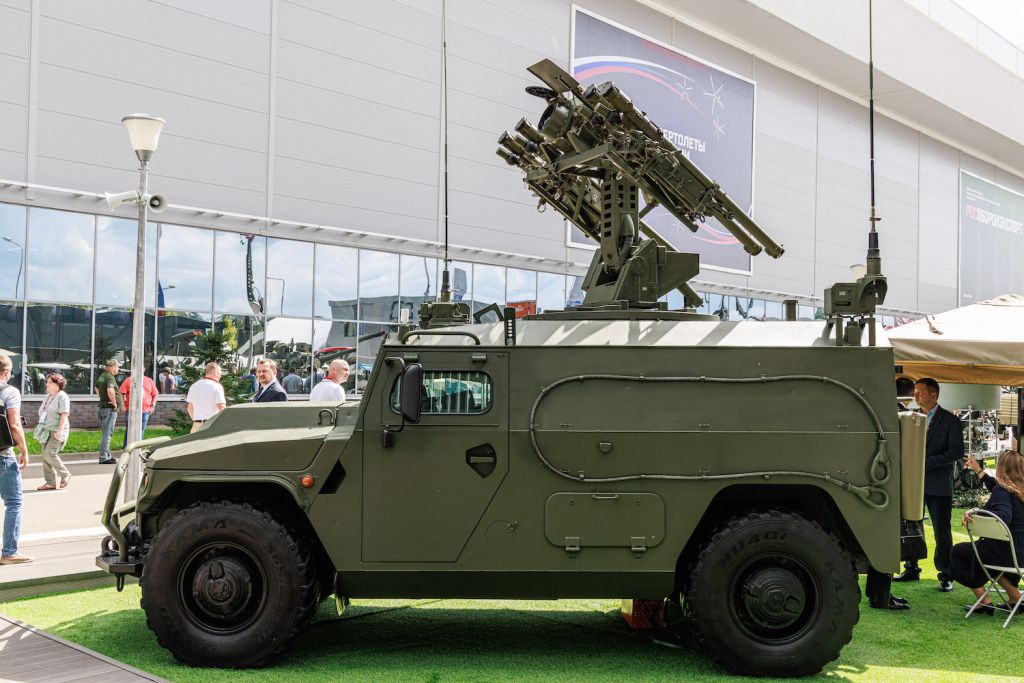
The GAS-2330 Tigr special-purpose protected tactical vehicle is used as a base for the system. A gunner fighting vehicle is the basic fighting unit of the system. Four launch containers for the standard Igla-S and Verba MANPADS are used as the main weapons. Another four MANPADS are in the ammunition stowage inside the tactical vehicle.
The Gibka-S crew includes a driver, squad leader and two anti-aircraft gunners. Air surveillance, target search and target data acquisition missions for the tactical vehicles are assigned to the reconnaissance and squad commander’s vehicle. The GAZ-2330 Tigr is used as the base.
The reconnaissance and squad commander’s vehicle provides air search at ranges up to 40km. All localized target data can be transferred to the squad’s fighting vehicles from the reconnaissance and squad commander’s vehicle that is provided with necessary communications systems. The guaranteed stable communication range between the gunner fighting vehicle and reconnaissance and squad commander’s vehicle in transit is at least 8km. The commander’s vehicle can operate other system weapons in the range of 17km. The Gibka-S reconnaissance and commander’s vehicle is operated by the crew of three persons: a driver, commander and radiotelephone operator. Capabilities of the new command post vehicle version allow simultaneous operation of six gunner fighting vehicles.
Testing of the Gibka-S surface-to-air missile system was completed in 2019, the system is currently produced on a large scale. Today the Gibka-S is used for the special military operation and receives recognition for its fighting performance. The system is able to effectively counter enemy planes, helicopters, UAVs, cruise missiles and other air threats.
High-Precision Systems holding provides continuous and full technical support of the system and its components. According to the feedback from the battle crews of the Russian Armed Forces, the Gibka-S missile system doesn’t give any chance to enemy aerial weapons beginning with various types of drones such as Baba-Yaga, Furiya, Valkiriya, etc. The Gibka-S surface-to-air missile system is an important and effective component of army air defence system and a strong guard of air space.