
A Contract for Supply of Uralvagonzavod’s T-90S Tanks to India Marks it 25th Anniversary
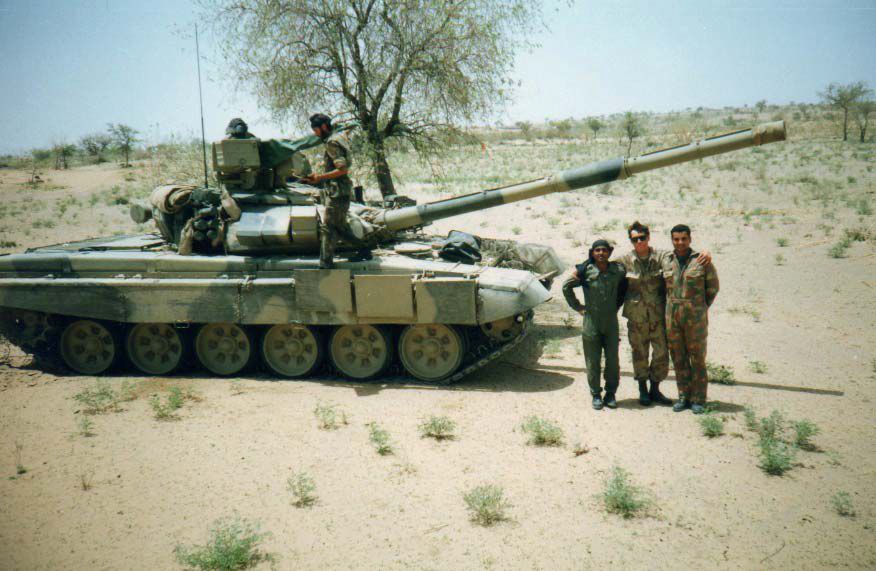
The contract helped the company keep its battle tank production and served as an incentive for revival of Russia’s tank industry
Photo: Uralvagonzavod
A contract for supply of Russian T-90S to India was signed 25 years ago, on 15 February 2001. This event has become not only a landmark in the history of Uralvagonzavod (as part of Rostec’s UVZ concern), but also a milestone for Russia’s whole defence industry, opening a new era for thr tank manufacturing sector.
In the late 1990s, Russia’s defence industry was in a grave condition. Companies were left without orders, highly-skilled professionals quited, and cooperation ties were broken. In these conditions, Uralvagonzavod and Urals Rail Car Design Bureau took up the challenge, which shaped the future of the industry.
In 1998, India expressed its interest in purchasing the modernized T-90S equipped with a 1000hp engine and modern thermal sight.
A new engine was designed and tested in just a year. A welded turret with a new weapon station configuration was proactively designed. The first thermal sight in the history of the national tank manufacturing was developed and integrated in the fire-control system.
As soon as on 17 May 1999, three T-90S prototypes were sent to Thar Desert where they covered a distance over 2000 km. Testing lasted about two months in extreme conditions. Huge temperature drops, off-road terrain, sands and sandstorms, and then tropical forests with damp air. Tanks climbed enormous sand dunes in 45°C heat. Engines hadn’t enough time to cool down at night because the temperature never fell below 30°C. The T-90S passed successfully even a sudden rainstorm test. The vehicles proved their performance in extreme environment.
Russian professional team continuously demonstrated ease of maintenance and maintainability of the tanks, all necessary maintenance and repair operations, including engine removal and maintenance test, were carried out in field conditions using authorized spare parts, tools and accessories. The Indian side was impressed by the test results: Brigadier General D. Singh called the T-90S “the second deterrent after nuclear weapons”.
Only four years had passed since the first prototype demonstration at the international defence exhibition in Abu Dhabi (UAE) in 1997 to the day of signing the contract, which is the shortest-ever time for such large-scale deals. The concluding document signed between Rosoboronexport and the Ministry of Defence of India in February 2001 provided the supply of finished tanks and semi knocked down sets for assembly in India.
“Rosoboronexport’s contract for supply of the T-90S tanks to India was a lifeline for Russian tank manufacturing, whose portfolio for 2001 included a domestic purchase order for just three vehicles. Moreover, it gave a huge incentive to the Russia’s whole machine building industry, which currently employs more than three million people,” said Rosoboronexport press office. “India in turn has received advanced technologies and launched production of Russian tanks at national facilities. Within the framework of the Make in India program, we offer further cooperation to our Indian partners and are willing to assist in organization of the advanced Т-90MS tank manufacturing. It can be produced at the same facilities where production of the T-90S/SK has been established.”
The contract not only helped Uralvagonzavod keep its battle tank production line, but also served as an incentive for revival of Russia’s whole tank industry. Cooperation between subcontractors has been restored, professional team has been brought back and production lines have been upgraded. Most of all, a powerful research and technological groundwork has been established for developing new tanks.
“At that time, Uralvagonzavod proved its capability to meet challenges of any level of complexity. Nowadays when some experts consider tanks obsolete as a class of weapons, reality proves otherwise. Tank is still an indispensable tool in a battle field, being a combination of striking power, protection and mobility. Modern conflicts just prove that none of the world’s armies can do without armored vehicles. But the future tank is not merely an armored tracked vehicle, but a highly intelligent fighting system. Tank manufacturing doesn't stay in the same place, but evolves. Tanks are becoming high-tech, powerful and robust. And Uralvagonzavod is at the sharpest edge of this evolution,” said Uralvagonzavod press office.
Experience gained from creating the T-90S facilitated the development of a next generation tank, the T-90M/MS. It is distinguished from the T-90S not only by its index, but also by all-new unified turret module with a new fire-control system, new command controllability management systems and increased protection. Almost everything has been changed — from the upgraded tank gun and engine to the tank weapon station ergonomics. The new tank is a successor of the T-90S and is ready for export as an exemplar of Russia’s advanced technology.
The T-90M Proryv is being continuously transformed on the basis of an enormous data array gathered in the field. It is currently the world’s most widely used modern tank.