
AI Doctor: How Artificial Intelligence Changes Medicine

How artificial intelligence helps identify and treat diseases and whether it can ultimately replace a human doctor
Photo: Rostec State Corporation
Technologies based on artificial intelligence become increasingly important in medicine and healthcare. Even now experts highly appreciate the potential of neural networks and other AI technologies in these applications.
Read below how artificial intelligence helps doctors and affects the quality of life.
From the first neural networks to national projects
The history of artificial intelligence dates back to 1957 when Frank Rosenblatt, and American psychologist, created a perceptron — a mathematical model of brain’s perception of data, one of the world's first neural networks. The Mark I electronic machine developed on the basis of this model in 1960 was the world’s first neural computer. ELIZA program, a chatbot for communication between humans and machines, developed at the Massachusetts Institute of Technology in the 1960s may be considered as the first application of AI in medicine. ELIZA was able to communicate with a patient on behalf of a therapist.
A federal project Artificial Intelligence is implemented in Russia. It is part of the national project Digital Economy that encompasses AI development efforts for healthcare applications. A set of AI standards in the field of medicine has been adopted over the past years. It means that a strong focus is made on artificial intelligence systems designed for population health improvement at the national level.
NTechMed: aid to medical personnel from the leader in video analytics
Big data analysis is one of the most important AI applications. Machine learning algorithms can interpret medical images — X-ray, MRI or CT images. They learn on the existing images, and their task is to discover anomalies to a high degree of accuracy, thus, providing faster diagnosing.
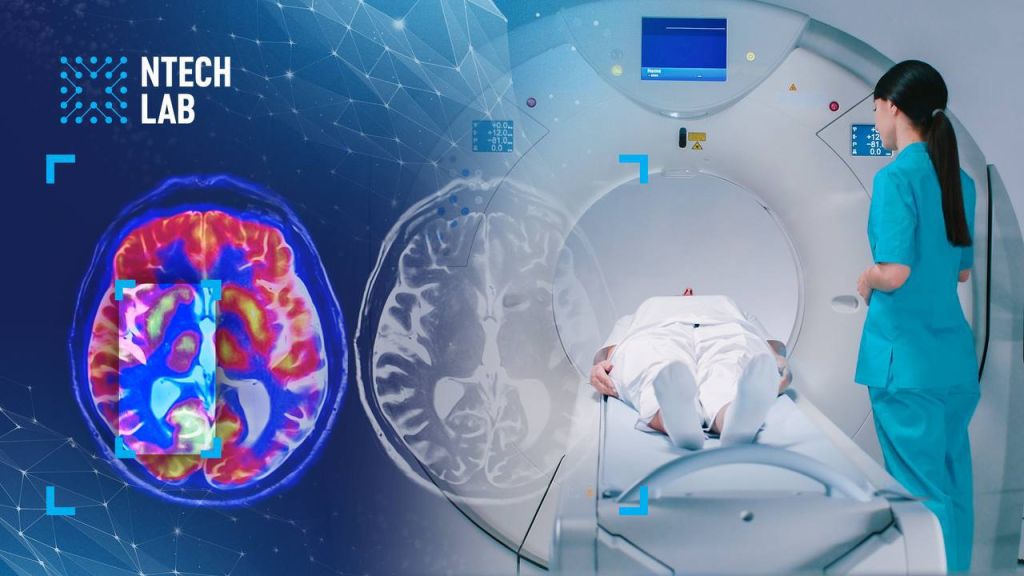
Several projects of this kind are currently being implemented in Moscow. One of them is NTechMed complex service for brain CT analysis offered by NtechLab, a technology partner of Rostec State Corporation and a leader in AI video analytics.
NtechLab team taught AI how to diagnose hemorrhagic and ischemic strokes. With the highest degree of accuracy, the CT image analysis time has decreased fourfold: From 20 minutes to 5 minutes, which helps doctors proceed to treatment urgently and improves prognosis for patients. A synergistic effect of introducing AI in medical practice will provide significant increase in CT image analysis accuracy and improvement in medical care efficiency. This solution was tested at the Center for Diagnostics and Telemedicine, certified and is currently being introduced in Russian clinics.
A new service offered by NtechLab — NTechMed CT Brain — is at its testing and certification stage. It helps doctors handle all CT and MRI scans faster and more reliably because all routine measurements to be conducted by the doctor are undertaken by AI that performs them to the highest degree of accuracy.
How AI is used in other areas of medicine
You also cannot do without neural networks in medical education. Creation of virtual simulations makes it possible to avoid natural constraints caused by the lack of practice. Virtual patients not only have a set of symptoms, but can also respond to the student’s actions to help learning how to make diagnosis and prepare treatment plans. A virtual simulator can be used to simulate an actual clinical case and train your skills before a complicated medical operation.
Personalized medicine is another important trend in using neural networks. AI can consider personal characteristics of patients when choosing therapy. Genomic data analysis systems forecast a patient’s response to particular drugs. Thus, a risk of side effects can be mitigated and treatment efficacy can be increased. This is especially important for oncology where a combination of the vast number of factors shall be considered. NtechLab is going to launch a tumor detection product in the nearest future.
Telemedicine also cannot do without artificial intelligence. Due to the lack of qualified medical personnel, especially in far regions, smart systems can perform preliminary examination of patients and propose treatment recommendations. An AI assistant, with data from tens of thousands of studies embedded into its learning, becomes a full participant of the diagnosing and therapeutic approach elaboration process. Chatbots that use natural language processing techniques can answer patients’ questions in the course of treatment and remind of the drug intake time to improve the treatment efficacy.
AI also doesn’t stay on the sidelines in the mental health area. Modern mobile applications may use AI algorithms for monitoring users’ moods and advising on mental and emotional state improvement. This may include meditation retreats, physical exercises or advice on communication with metal health professionals.